How Many Calories in Chicken Breast: Macros Table
Published 2026-08-18 · 4 min read
Chicken breast is a staple for anyone watching their diet: lots of protein with very little fat, which is why it is loved both for weight loss and for building muscle. But there is no single number: calories depend a lot on how it is cooked and whether the breast has skin on. Below are ballpark figures and a macros table.
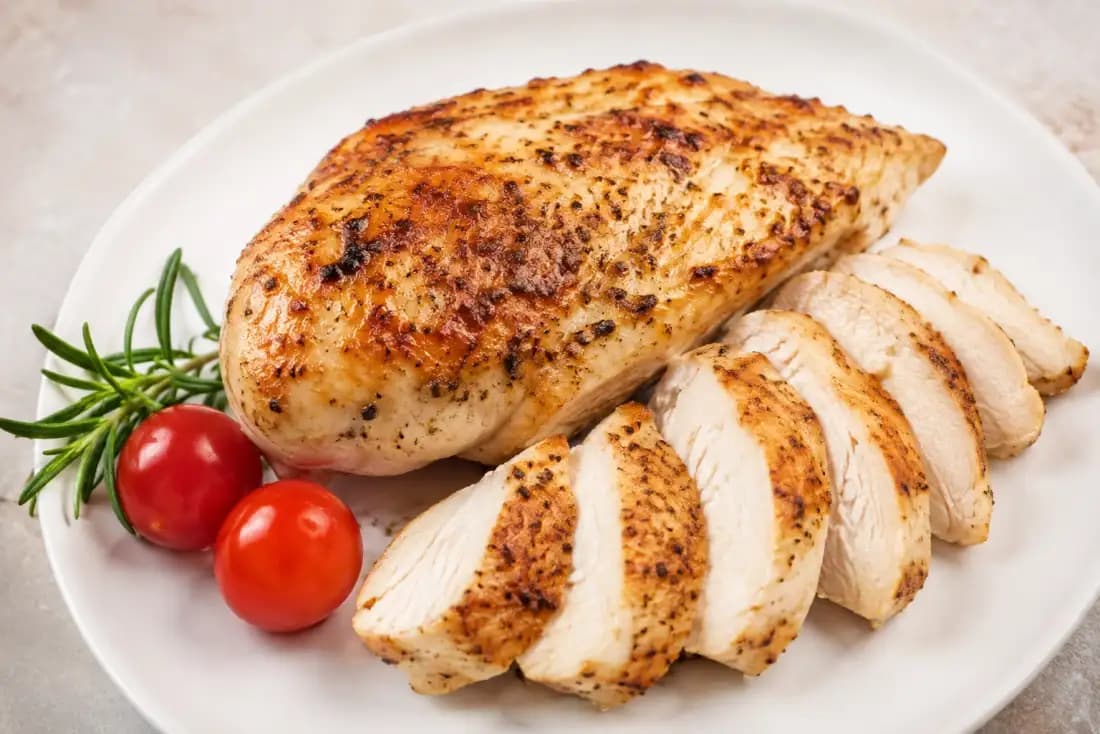
How many calories in chicken breast per 100 grams
Raw skinless chicken breast fillet contains roughly 110–120 kcal per 100 grams — almost pure protein with minimal fat. During cooking the meat loses water and the portion shrinks, so the same 100 grams carries slightly more calories and protein.
Boiled or steamed skinless breast is about 115–130 kcal per 100 grams, baked or grilled without oil is roughly 150–165 kcal. Frying in oil pushes it to 200–240 kcal and up, and the skin adds another 50–70 kcal. These are ballpark figures, not exact values — the result depends on the recipe, so it is best to count your specific portion.
Chicken breast macros table (approximate)
Approximate values per 100 grams for skinless fillet unless noted otherwise:
- raw (skinless): ≈115 kcal, protein ≈23 g, fat ≈2 g, carbs 0 g;
- boiled / steamed: ≈125 kcal, protein ≈29 g, fat ≈2 g, carbs 0 g;
- baked / grilled without oil: ≈160 kcal, protein ≈30 g, fat ≈3.5 g, carbs 0 g;
- fried in oil: ≈220 kcal, protein ≈27 g, fat ≈12 g, carbs 0–3 g;
- baked with skin: ≈200 kcal, protein ≈28 g, fat ≈9 g, carbs 0 g.
What the calorie count depends on
The meat itself barely changes, but the cooking method and add-ons move the number a lot:
- skin — whether you remove it or not: with skin there is noticeably more fat and calories;
- oil when frying — the breast soaks it up, and calories can grow one and a half to two times;
- breading (flour, breadcrumbs, batter) — adds carbs and soaks up even more oil;
- sauces — creamy, cheese or mayo-based sauce easily adds a hundred or two calories per portion;
- portion size — by eye it is easy to mistake a 200 g breast for 150 g and undercount calories.
Why chicken breast is handy for tracking
The breast is prized for protein: about 29–30 g per 100 grams of cooked meat at a low calorie count and almost zero fat. Such a food helps you stay full longer, preserves muscle during a calorie deficit and fits neatly into your daily target — which is why the breast is so popular both on a cut and while gaining muscle.
To keep the portion light, cook the breast skinless — steamed, boiled or baked without oil — and add creamy and cheese sauces sparingly. Then a healthy protein meal does not turn into a hidden 500+ kcal because of oil and sauce.
How to count your own portion
Since the cooking method and add-ons differ for everyone, the most accurate figures come from your specific plate. Photograph the breast in Calvero: the service estimates calories and macros from the picture, and if it was cooked differently, correct it with text ("steamed, skinless", "fried in oil", "with cheese sauce", "large portion") and the count recalculates.
You can count in the browser or right inside Telegram. There is a free trial with a few analyses — no card required.
Frequently asked questions
How many calories are in 100 g of chicken breast?
About 110–120 kcal per 100 g of raw skinless fillet, and 150–165 kcal boiled or baked: cooking drives off water and concentrates the meat. Frying in oil adds calories on top.
How much protein is in chicken breast?
About 22–23 g of protein per 100 g with very little fat (1–2 g). It is one of the most protein-dense foods, which is why breast is popular for cutting and for building muscle.
How many calories are in boiled chicken breast?
About 150–165 kcal per 100 g of boiled skinless fillet. Boiling adds no calories, but water leaves the meat, so the per-100-g figure for the cooked piece is higher than for raw.
Is chicken breast with skin higher in calories?
Yes — the skin adds fat: breast with skin is about 190–220 kcal per 100 g versus ~165 without. If you are counting calories, it is easiest to remove the skin before or after cooking.
This content is for informational purposes only and is not medical or dietetic advice. Consult a doctor or a registered dietitian before changing your diet.