How Many Calories in Rice: Macro Table
Published 2026-08-18 · 4 min read
Rice is the most common side dish: it goes with meat, fish and vegetables, and forms the base of pilaf and sushi. But calories here are easy to get wrong — the same "per 100 grams" figure means something very different for raw grain and for the cooked result. During cooking rice absorbs water and grows two and a half to three times heavier, so 100 grams of raw rice and 100 grams of cooked rice are not the same thing at all. Here are the ballpark figures and a macro table.
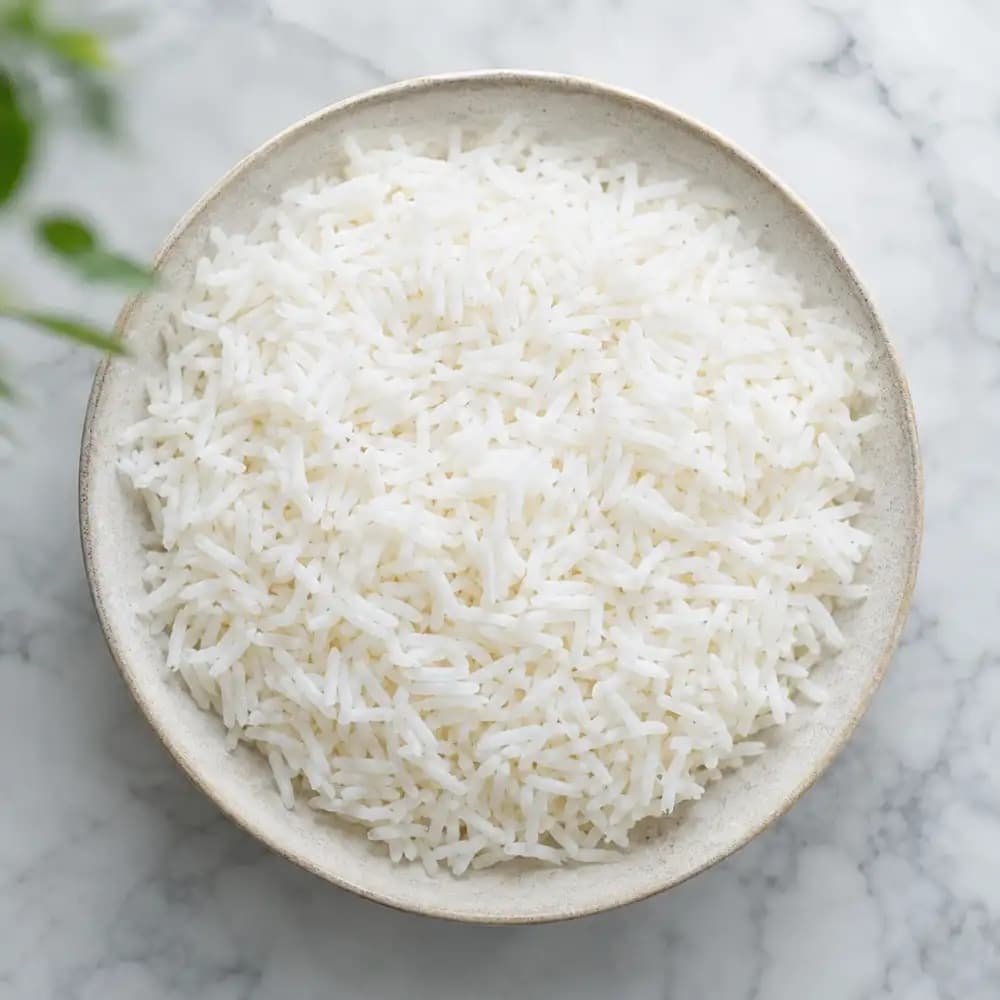
How many calories in rice per 100 grams
Raw white grain, before cooking, is about 340–360 kcal per 100 grams. But that is not what you eat: the plate holds already-cooked rice. As it boils the grain takes on water, the same portion spreads out 2.5–3 times by weight, and the calories per 100 grams drop accordingly.
Cooked white rice in water is roughly 115–130 kcal per 100 grams of the finished product. Brown (unpolished) cooked rice is slightly lighter — about 110–120 kcal — but higher in fiber. Parboiled rice, once cooked, is close to plain white. These are ballpark values, not exact ones: a lot depends on the variety, the amount of water and any add-ins.
Rice macro table (approximate)
Approximate values per 100 grams. Note the gap between raw grain and cooked rice:
- white rice, raw (before cooking): ≈345 kcal, protein ≈7 g, fat ≈1 g, carbs ≈78 g;
- white rice, cooked in water: ≈125 kcal, protein ≈2.5 g, fat ≈0.3 g, carbs ≈28 g;
- brown rice, cooked: ≈115 kcal, protein ≈2.6 g, fat ≈1 g, carbs ≈23 g;
- parboiled rice, cooked: ≈120 kcal, protein ≈2.7 g, fat ≈0.4 g, carbs ≈26 g;
- fried rice (with oil, vegetables, egg): ≈150–190 kcal due to the added oil.
What the calorie count depends on
The main trap is confusing raw and cooked rice. But even cooked, the figure moves around, and here is why:
- raw vs cooked — the key point: 100 g of raw rice yields about 250–300 g cooked;
- oil and sauce — a spoon of oil in the pan or a creamy sauce easily adds 50–100 kcal to a serving;
- fried vs boiled — frying is almost always more calorific because of the oil;
- add-ins — vegetables are light, but egg, sausage or cheese in "special" rice noticeably raise the total;
- serving size — a side estimated by eye easily turns 150 g into 250–300 g, and that is an extra hundred calories.
Why rice is convenient for tracking
Rice is a simple source of carbohydrates: it is almost fat-free, filling, and pairs easily with a protein base (chicken, fish, legumes). For anyone counting calories it is convenient by being predictable — if you know the weight of the cooked portion, the number is easy to estimate.
To keep the side light, boil the rice rather than frying it, go easy on oil and rich sauces, and watch the portion size. Brown and parboiled rice give a bit more fiber and keep you full longer — but calorie-wise they are close to white, so what really matters is the way it is served and the size of the portion.
How to count your exact serving
Since the variety, cooking method and add-ins differ for everyone, the most accurate numbers come from your specific plate. Photograph your rice in Calvero: the service estimates calories and macros from the picture, and if the preparation is different, correct it in words ("fried in oil", "boiled brown rice", "with vegetables and egg", "large portion") and the count recalculates.
You can track it in your browser or right inside Telegram. There is a free trial with several analyses — no card required.
Frequently asked questions
How many calories are in 100 g of cooked rice?
About 110–130 kcal per 100 g of boiled white rice in water. As it cooks, rice absorbs water and weighs 2.5–3 times more than dry grain, so the per-100-g figure for the finished dish is much lower than for the raw grain.
How many calories are in 100 g of dry rice?
About 330–350 kcal per 100 g of dry rice grain. But 100 g of dry rice yields 250–300 g cooked, so on the finished side dish the “per 100 g” number comes out 2.5–3 times smaller.
How many calories are in a serving of rice?
A standard 150–200 g portion of cooked rice is roughly 170–260 kcal. Oil, sauce or frying add another 50–150 kcal, which is why pilaf and fried rice are counted separately.
Which rice is lower in calories — brown or white?
By calories, brown and white rice are nearly identical — about 110–130 kcal per 100 g cooked. The difference is fiber: brown rice is more filling and digests slower, but calling it “lower-calorie” is inaccurate.
This content is for informational purposes only and is not medical or dietetic advice. Consult a doctor or a registered dietitian before changing your diet.